“I don’t have time for a newsletter.” I hear this from interior designers more often than anything else when the topic of marketing comes up. And I get where it’s coming from—between client visits, site supervision, preparing renders, and managing contractors, it’s hard to find an hour to write emails to people who might use your services someday. The problem is that “someday” arrives faster than you think, and a studio that isn’t building a contact database has to start its client acquisition from scratch every single time.
Imagine having a list of five hundred, a thousand, or two thousand people who specifically asked to hear from you. People who downloaded your bathroom renovation checklist, took your interior style quiz, or signed up for your guide. Every single one of them is a potential client—if not today, then in six months when they start a renovation or buy a new apartment. And instead of spending money on ads to reach them, all you have to do is send one email.
In this article, I’ll show you how to build such a database almost on autopilot using ManyChat, a simple lead magnet, and an integration with an email marketing tool. You don’t need to be an email marketing specialist or spend hours a week on it. All it takes is one smart implementation and a bit of consistency.
Why a mailing list is your design studio’s most valuable asset
Before we dive into the specifics, I want to explain why a subscriber base is so vital—and why it’s worth building even when your calendar is fully booked for months to come.
Social media is “rented land,” not ownership. Your Instagram profile, Facebook page, Pinterest account—all of these belong to platforms that can change the rules of the game at any moment. An algorithm that shows your posts to a thousand people today might limit your reach to two hundred tomorrow. An account can be blocked, a platform can lose popularity, and ad costs can skyrocket. You have zero control over any of these scenarios.
A mailing list is a different story. It is your property—a collection of email addresses from people who have given you explicit permission to contact them. No one can take this list away from you, no algorithm decides whether your message reaches the recipient, and no change in terms of service will cut off your access to your contacts. In a world where social media platforms shift year to year, a mailing list is the only communication channel you fully control.
Then there’s the financial aspect. Acquiring a single client through Facebook ads can cost anywhere from dozens to hundreds of dollars. Sending an email to someone already on your list costs a fraction of a cent. The larger your database, the lower your cost of reaching potential clients, making you less dependent on paid ad campaigns.
Finally, a mailing list allows you to nurture relationships over time. Interior design is rarely an impulse buy. Months or even a year can pass from the moment someone starts thinking about a renovation to the moment they sign a contract with a designer. A newsletter keeps you at the top of a potential client’s mind throughout that period. When the moment of decision arrives, you’ll be the first person they think of—because you’ve been regularly providing value and building your image as an expert.
Lead magnets: What they are and how to choose the right one for your studio
A lead magnet is a free resource you offer a potential client in exchange for their email address or permission to contact them via Messenger. The name sounds technical, but the idea is simple: you provide something valuable for free, and in return, you gain the ability to continue communicating with someone who has shown interest in your field.
A good lead magnet must meet three criteria. First, it solves a specific problem or answers a specific question. Second, it is quick to consume—a client should be able to read or use it within ten to fifteen minutes. Third, it is directly related to your services, ensuring it attracts potential clients rather than random internet users.
Here are proven lead magnet formats for the interior design industry:
Checklists
This is the easiest and fastest format to prepare. It only requires you to take knowledge you already have and turn it into a concise, organized list. Examples:
- “10 Common Small Bathroom Mistakes That Cost a Fortune”
- “Pre-Renovation Checklist: 15 Things to Remember Before the Contractors Arrive”
- “7 Steps to a Functional Kitchen You’ll Actually Want to Cook In”
Checklists work perfectly because they promise specific value in a condensed form. A client sees the title, knows exactly what they’ll get, and is happy to provide an email for a resource that only takes five minutes to read.
Short guides or E-books
A more detailed format that allows you to dive deeper into a topic and showcase your expertise. It doesn’t need to be a novel—eight to fifteen pages in a PDF format with nice graphics and actionable tips is plenty. Examples:
- “5 Steps to Achieving the Scandinavian Style in Your Home”
- “How to Choose Colors for Your Apartment: A Guide for the Undecided”
- “Small Apartment, Big Potential: Smart Design for 400 Square Feet”
An e-book takes more work than a checklist, but it also builds a stronger perception of you as an expert. Someone who reads your guide and finds it valuable will have much higher trust in your services than someone who only saw an ad.
Interactive Quizzes
This format often generates the highest conversion rates because it engages the user and provides a personalized result. Example: “What is your interior design style? Take the quiz and discover the aesthetic that fits your personality.”
The quiz consists of several questions about preferences (warm vs. cool colors, wood vs. metal, minimalism vs. maximalism), and ends with a result: “Your style is Scandi with Japandi elements,” along with a brief description and sample photos. To see the full breakdown, the user provides their email address.
Regardless of the format you choose, remember one rule: the lead magnet must be truly valuable. If a client downloads a checklist and finds it trivial or irrelevant, they won’t just ignore your services—they’ll unsubscribe and remember your studio as a place that overpromises and under-delivers. It’s better to have one excellent resource than five mediocre ones.
How the lead magnet funnel works in ManyChat
The mechanism is simple and consists of a few steps that a client completes in a minute or two. Every step is automated, so after the initial setup, your only job is to watch the list grow.
The Greeting and Lead Magnet Description
The chatbot greets the client and briefly describes what they are about to receive. For example: “Hi! Glad you’re here. I have our checklist ready for you—10 Common Small Bathroom Mistakes That Cost a Fortune. We’ve compiled this based on hundreds of projects. To get it, I just need your email address.”
This is short, specific, and explains why the bot is asking for an email. Transparency builds trust—the client knows they are trading their data for something of value.
Collecting the Email Address
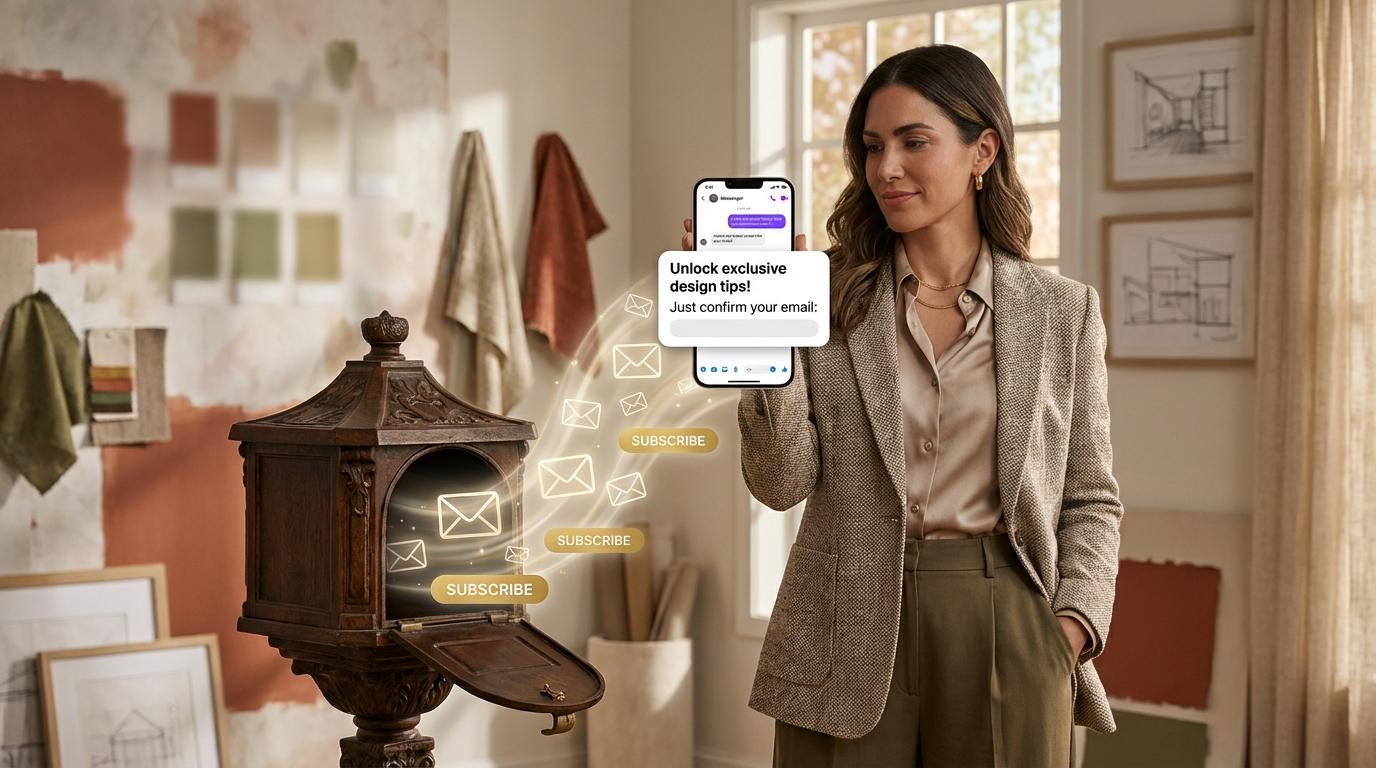
ManyChat has a built-in feature for collecting email addresses. The chatbot displays a text field, and the client enters their address. The system automatically verifies that the format is correct and asks for a re-entry if there’s a typo.
This is the heart of the funnel. You now have two channels to reach the client: Messenger (where the conversation is already happening) and email (where you’ll send your newsletter). This double-channel approach significantly increases the chance your message will be seen.
Syncing with your mailing list
Once the email is collected, ManyChat automatically sends it to your email marketing tool. Integration with MailerLite, Mailchimp, ActiveCampaign, or ConvertKit happens directly within ManyChat (in the Pro version) or via Zapier/Make. Setup takes minutes and requires no coding.
The address lands on the appropriate list (e.g., “Bathroom Checklist Leads”), and the client automatically enters your welcome sequence. I’ll talk more about that sequence later in this article.
Delivering the Lead Magnet
After they provide their email, the chatbot immediately sends the promised material—through both channels simultaneously. In Messenger, the client receives the PDF file or a link. At the same time, a welcome email with the same resource arrives in their inbox.
Double delivery isn’t overkill—it’s strategy. A client who downloads a checklist in Messenger can easily find it again by scrolling through their chat history. A client who prefers organizing resources in their inbox will have it there. Either way, the material is easily accessible, which increases the likelihood of it actually being read.
Nurturing your list: What to send and how often
Collecting emails is just the beginning. The real value of a list reveals itself when you start communicating regularly with your subscribers. This is nurturing—turning an anonymous list of addresses into a community of people who know you, trust you, and want to work with you.
The Welcome Sequence
The first thing a new subscriber should receive (besides the lead magnet) is a short welcome sequence—a series of 2-3 emails sent during the first week after sign-up.
Email 1 (Day of sign-up): A welcome, a short story about your studio, and what the subscriber can expect. “Hi! Thanks for downloading our checklist. I’m [Name], an interior designer based in [City]. For [Number] years, I’ve been helping clients create spaces they love living in. In this newsletter, I share tips, inspiration, and behind-the-scenes looks at our projects once a month.”
Email 2 (3 days later): Valuable content related to the lead magnet. If they downloaded a bathroom checklist, send them an article on the latest bathroom trends or photos of one of your projects with a short breakdown.
Email 3 (7 days later): A gentle call to action. “If you’re planning a renovation or designing a new space and need support—reach out. I’d love to talk about your project during a short consultation.”
The Recurring Newsletter
For a design studio, the recommended frequency is once a month. This is frequent enough to stay top-of-mind, but infrequent enough that you don’t feel the pressure to churn out content every week. One email a month is twelve emails a year—a manageable amount even with a full project load.
As for content, here is a proven template you can repeat month to month:
- A new project or work-in-progress. Show 1-2 photos with a brief description of the challenge and how you solved it. This builds authority.
- A practical tip. A short paragraph with actionable advice, e.g., “How to choose the right color temperature for lighting.”
- An industry trend. Color of the year, a new finish material, or a shift in design philosophy.
- A Call to Action (CTA). Every newsletter should end with a specific offer: booking a consultation, viewing your full portfolio on Messenger, or taking a style quiz.
How to promote your lead magnet and grow your list fast
Facebook and Instagram Ads. This is the fastest way to build your list. Create an ad with an attractive graphic and a clear message: “Planning a bathroom renovation? Download the free checklist of 10 Mistakes That Cost a Fortune.” Set the campaign objective to “Messages.”
Instagram Bio Link. Instead of sending people to your homepage, use a link that opens Messenger with your lead magnet funnel. Anyone who visits your profile from hashtags or reels will have easy access to your free resource.
Organic Posts. Regularly publish content related to your lead magnet topic. If your checklist is about bathrooms, post bathroom project photos, tile selection tips, and layout inspiration. At the end of every post, add: “Want to avoid common mistakes? Download our checklist—link in bio.”
Comment Automation. In ManyChat, you can set an automatic reaction to comments. If someone writes “checklist” under your post, the bot can automatically DM them the invitation to the funnel. This is highly effective because it engages people who have already shown interest in your content.
Summary: Your subscriber base is your greatest marketing treasure
In a world where algorithms change every quarter, ad costs rise every year, and social platforms come and go, a mailing list is the only communication channel that truly belongs to you. Every email address on your list is a potential client—someone who specifically asked to hear from you.
Building this base with ManyChat is simpler than it seems. You need one good lead magnet, a configured chatbot funnel, and systematic promotion. The entire automation—from collecting the address to delivering the resource—works without your involvement. Your only recurring task is preparing one newsletter a month, which, with the right template, only takes an hour or two.
Start today. Pick one topic you know well and create a simple checklist. Set up your ManyChat funnel, connect your mailing tool, and launch your first campaign. In six months, you’ll have a database of hundreds of people who know your studio, trust your expertise, and are ready for a conversation when their time for a renovation comes.
Want us to help you build a lead magnet funnel and launch a newsletter for your studio? Contact us today—we’ll design a system that builds your client database on autopilot.
Get started with ManyChat and get 30% off
Test ManyChat at a lower price and claim 30% off for your first 3 months.